Baby Reflux and Sleep: What to Know Before Birth
If your baby turns out to be a spitter, the answer is not to tilt anything. Flat, firm and on the back stays the rule — the American Academy of Pediatrics says babies with reflux sleep exactly like every other baby, and inclined infant sleepers have been banned outright in the US since 2022. What genuinely helps happens in the daytime: smaller, slower feeds, real burping, and holding your baby upright for a while afterwards. Knowing that while you are still pregnant saves you buying three things at 2am that do not work.
I found all of this out at about week two, at speed, with a laundry pile.
Reflux in the newborn weeks, described honestly
Newborns spit up because the muscle at the top of the stomach is still soft and unhurried, and because a small stomach plus a mouthful of air is a bad combination. Milk comes back up, onto you, the sheet, and the one clean thing you were wearing.
The AAP’s reflux guidance sets out the arc: gastroesophageal reflux typically shows up around two to three weeks, peaks somewhere around four to five months, and has settled in most full-term babies by nine to twelve months. That is a long-feeling middle, and it is also, in the ordinary version, a laundry problem rather than a medical one.
The distinction worth carrying into the newborn weeks is between a baby who spits up and is otherwise content — feeding well, gaining, mostly cheerful between the mess — and a baby who is distressed by it. The first is the common story. The second is a conversation with your pediatrician, and it has a name, GERD, which you do not get to assign yourself.
Tales of a New Mom covers spit-up versus vomit properly, which is the exact question you will have at 3am while deciding whether this counts as a lot.
Why the flat rule does not bend for it
This is the part that feels wrong, and it is the part I most want you to have read in advance, because at 2am the internet will offer you a wedge.
The AAP’s safe sleep guidance is unambiguous: “Even babies with gastroesophageal reflux disease (GERD) should sleep flat on their backs,” and any surface that inclines more than 10 degrees is not a safe sleep surface. Its answer specifically on reflux goes further and closes off the workarounds one by one — elevating the head of the crib “is not effective in reducing GER” and is itself unsafe because the baby slides toward the foot of the bed; sleep positioners and nests are not recommended; and car seats, swings and reclined bouncy seats are “not safe sleeping environments.” The UK’s Lullaby Trust says the same thing in plainer words on its sleeping position page: don’t incline, tilt or prop the mattress, the cot or your baby, because it will not help the reflux.
The fear underneath the tilting instinct is choking, and it is worth naming so you can put it down. The AAP’s position is that babies cough up or swallow what comes back, because the gag reflex is doing its job.
So: the sleep surface is not a lever you get to pull. Everything else is.
What actually helps, and it is all before the baby is put down
None of it is clever, and all of it is easier to learn now than to learn tired.
Feed smaller, more often. A stomach that is not overfull has less to send back. The AAP’s own suggestion list starts here.
Slow the feed down. Gulping brings air. If you are bottle feeding at all, paced bottle feeding is a ten-minute thing to learn and it is the single technique I wish I had known first time.
Burp during, not only after. Mid-feed as well as at the end. The New Moms Club has how to burp a newborn, which is more of a skill than anyone admits.
Hold them upright afterwards. Roughly twenty to thirty minutes, awake and supervised, before anything else happens. This is the one that eats your evening, and it is also the one that works.
Don’t bounce a full baby. Active play right after a feed is asking for it.
And the thing that is not on this list: anything involving thickening feeds or medication is a pediatrician’s call, not a home experiment.
The registry edit this makes for you
Cross off the whole category of things sold to tilt a baby. Inclined sleepers are not a judgement call any more — under the Safe Sleep for Babies Act they have been banned hazardous products since November 12, 2022, defined as any sleep surface inclined more than 10 degrees for a baby under one. Wedges, positioners and nests go the same way. So does the plan where the baby sleeps in the swing because it is the only place they settle.
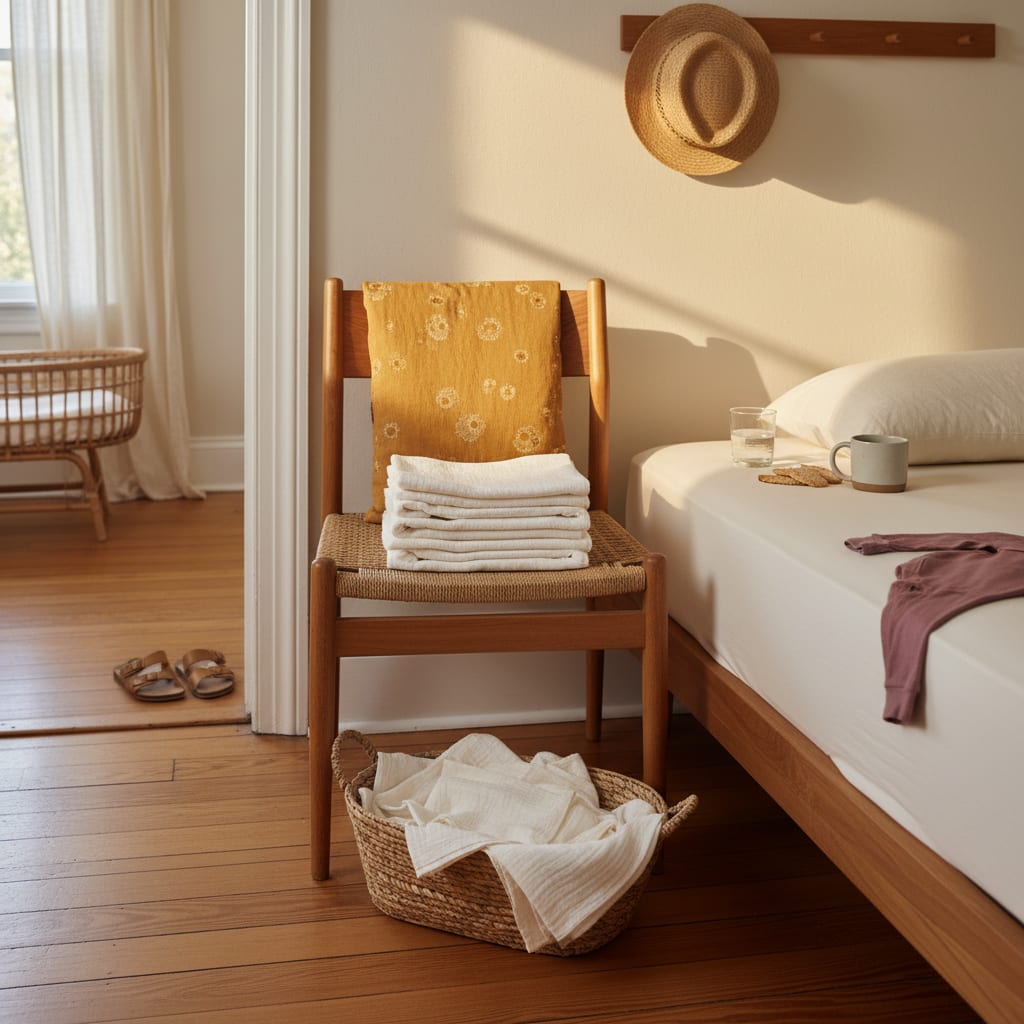
What you want instead is dull and cheap: more fitted sheets than feels reasonable, and a pile of absorbent cloths within arm’s reach of everywhere you will feed. Four-layer muslin ones like the aden + anais Burpy Bib hold considerably more than a folded flannel, which matters at 4am when the alternative is changing the sheet. Any thick muslin does the job; the point is quantity and where they live.
The sleep space itself does not change at all. It is the same firm, flat, boring setup described in the newborn sleep space — the CPSC’s line is that the safest place for a baby is “a flat, bare surface dedicated to the infant,” and reflux does not add a clause to that. If you build it now, you will not be tempted to renovate it at 2am on the strength of a video.
If you want the fuller picture of how reflux plays out across a night, Betteroo’s guide is honest that the answer is mostly patience plus feeding mechanics, which is not what anyone wants to hear and is what the evidence supports. Having a sleep plan that adjusts as the weeks go rather than one you rebuild every time something changes is genuinely more useful when your baby is the messy kind.
 Sort the plan now — while both hands are free
Betteroo turns a two-minute quiz into a day-by-day newborn sleep plan that adjusts as your baby changes. Do it in a quiet evening rather than a loud night.
Take the 2-minute sleep quiz →
Sort the plan now — while both hands are free
Betteroo turns a two-minute quiz into a day-by-day newborn sleep plan that adjusts as your baby changes. Do it in a quiet evening rather than a loud night.
Take the 2-minute sleep quiz →
Call your pediatrician if…
Everything above is about the ordinary version. Per the AAP’s reflux guidance, ring your pediatrician if your baby refuses feeds, cries or arches during them, if there is blood or anything green in the spit-up, if it suddenly gets more frequent or more forceful, if the belly looks swollen or feels hard, if there is wheezing or persistent coughing, or if weight gain slows or there are fewer wet and dirty diapers. Forceful vomiting after every single feed is its own reason to call the same day. Nobody at that office thinks you are overreacting.
And while you are still pregnant, the usual list stands: bleeding, leaking fluid, contractions before term, severe headache or vision changes, sudden swelling of your face or hands, fever, severe abdominal pain, a fall, fainting, or any change in your baby’s movement pattern all mean call the same day.
FAQ: reflux and newborn sleep
Can I raise one end of the crib mattress if my baby has reflux?
No. The AAP says elevating the head of a crib is not effective for reflux and is unsafe, because the baby slides down toward the foot of the bed. The surface stays flat.
Is it safe for a refluxy baby to sleep on their back?
Yes. The AAP is explicit that babies with GERD still sleep flat on their backs, and that the gag reflex means back sleeping does not raise choking risk.
When does baby reflux stop?
It usually appears at around two to three weeks, peaks around four to five months, and has resolved in most full-term babies somewhere between nine and twelve months.
What should I buy before birth if I am worried about reflux?
Nothing that tilts. Spare fitted sheets, a stack of absorbent cloths, and the same flat safe sleep setup everyone else uses — the prep worth doing is in setting up newborn sleep before the baby comes.
Does reflux mean the newborn weeks will be worse?
Messier, mostly. The shapelessness described in what newborn life is actually like is the same either way; reflux mainly adds laundry and upright time to an already odd day.