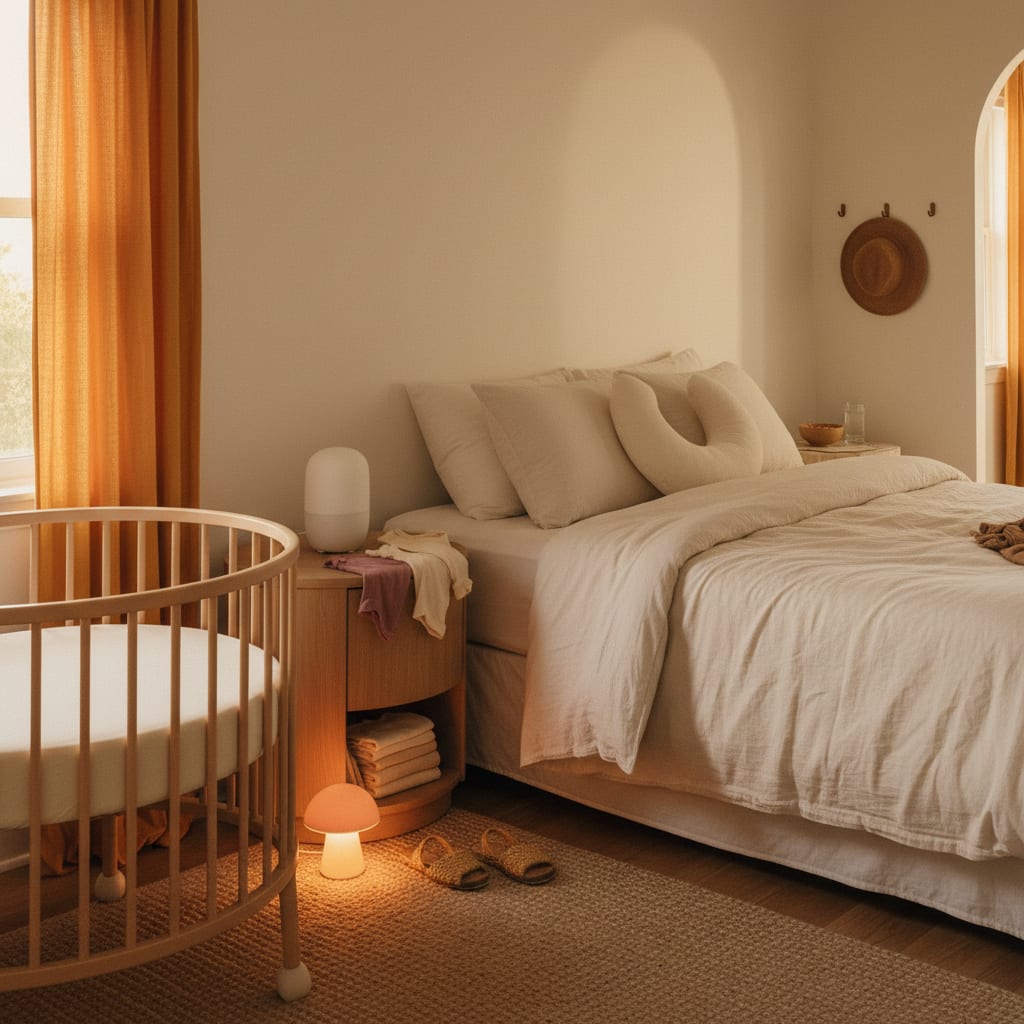
The Newborn Sleep Space: Safe Setup, Step by Step
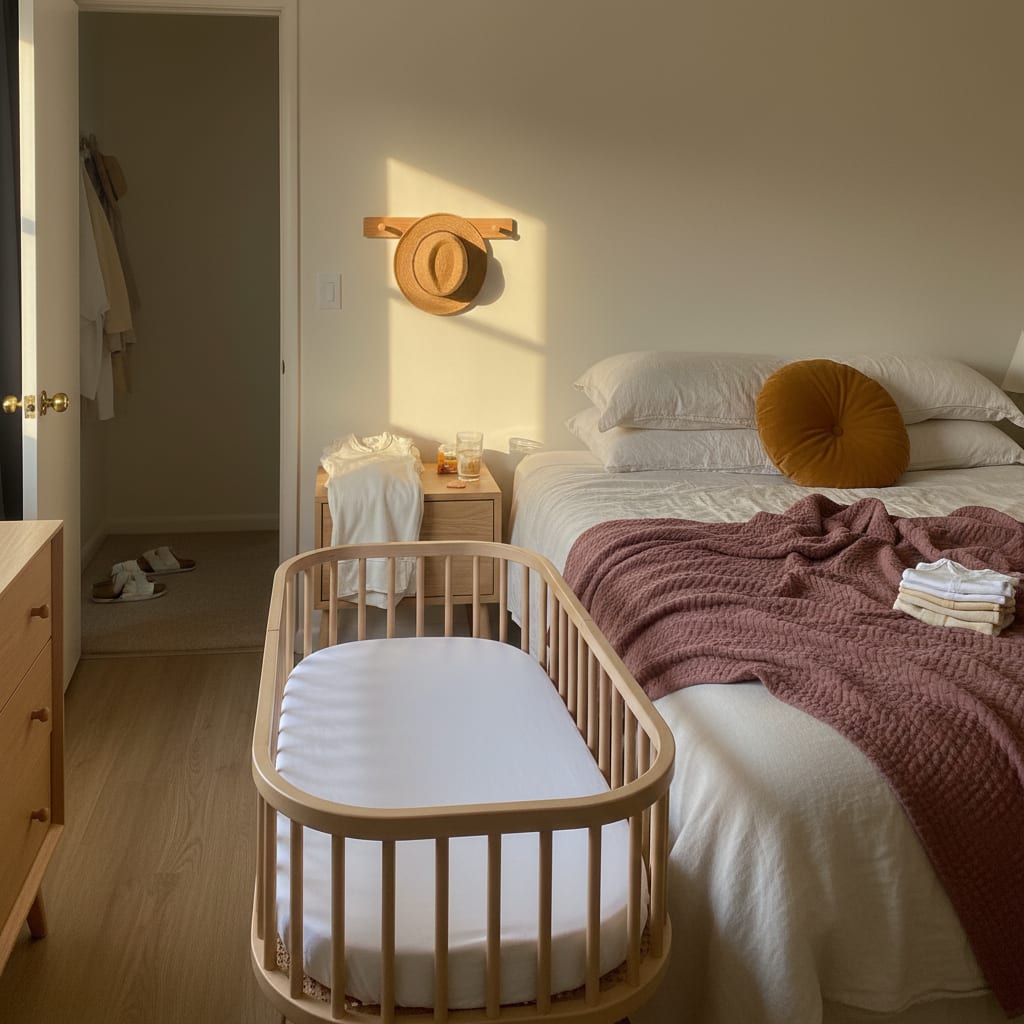
A newborn sleep environment setup has one governing principle: boring is safe, and safe is boring. Per the American Academy of Pediatrics, the baby sleeps alone, on their back, on a firm flat surface in a bare bassinet or crib — no blankets, pillows, bumpers, or stuffed anything — ideally in your room for the first six months. Around that fixed core, you’re arranging four practical layers: placement you can reach at 3am, darkness you can control, steady sound, and a night-feed station so nobody’s rummaging in the dark. One afternoon, done.
Here’s the step-by-step, in the order I’d actually do it.
Step 1: internalize the spec (it’s short)
The AAP safe sleep guidance reduces to a sentence you can memorize: alone, on the back, in a bare crib or bassinet, on a firm flat surface, room-sharing but not bed-sharing, for the early months. Nothing in the sleep surface but the baby and a fitted sheet. Overheating is to be avoided — dress for the room, skip the hats indoors, no weighted anything.
Two consequences worth saying out loud. First: the Pinterest nursery and the safe nursery overlap by about 40% — the quilt, the bumper, the heap of lovies are decor for the room, not the bed. Decorate the walls to your heart’s content; the sleep surface stays empty. Second: if a product implies the rules don’t apply to it (incline sleepers, loungers marketed as “naps!”), the rules apply to it, and the answer is no — for actual sleep, only a flat, bare, certified sleep surface. When in doubt about a specific product, your pediatrician is the tiebreaker — this is exactly the kind of question they take.
Step 2: choose and place the bassinet
For the room-sharing months you want a bedside-height bassinet, placed so you can see and reach the baby without fully surfacing from sleep. The worked example here is the HALO BassiNest Swivel Sleeper 3.0 — its party trick is swiveling over the bed’s edge so night reaches don’t require standing, which your third-trimester back will also appreciate during the setup weeks. Plenty of simpler bassinets meet the same safety spec; what matters is the spec, the height, and honestly the width of the walking route — leave a clear, toe-safe path from your side of the bed, because you’ll walk it in the dark roughly four hundred times.
Placement rules: away from windows, blind cords, vents, and radiators; nothing hanging above; nothing within grab-or-fall distance. Boring position, boring surroundings. Boring is the aesthetic.
Step 3: engineer the light
Two light problems, two tools. Problem one: daytime naps in a bright room and summer 8pm bedtimes — solved by blackout curtains or shades, the cheap tension-rod kind included. (Darkness also helps the day-night confusion resolve — light is the main clock-setter.) Problem two: night feeds — you need to see, but a ceiling light at 3am is a family-wide system reboot. A dim, warm night-light at knee height, ideally one you can tap on with a foot or elbow, keeps feeds in low-power mode for everyone.
Step 4: add the sound layer
Steady background sound smooths the womb-to-world transition (the womb was loud) and — the underrated part — it blurs the household: the dishwasher, the doorbell, the toddler expressing opinions. The canonical worked example is the Yogasleep Dohm Classic, an actual mechanical fan in a shell with no app to fail. Placement: across the room, not inside the bassinet railing, at a volume like a steady shower — background, not foreground. Whatever machine you use, set it up now and run it at a few naps’ distance from your own pillow to check the whole room’s acoustics.
Step 5: stage the night station
Within arm’s reach of wherever the feeder sits: burp cloths, water for the adult, phone charger, a spare swaddle and diaper-change basics. The organizing principle of the entire room is no rummaging after midnight — every 3am need findable by touch. This is also where a plan beats improvisation: I’ve written about preparing the whole newborn-sleep operation before birth — expectations, night shifts, and the planning tools like Betteroo that turn “what do we do tonight?” into a question with a pre-loaded answer. The room is the hardware; that post is the software.
Step 6: the toddler-proofing pass (second-timers only)
If a big sibling roams your home: bassinet high enough that “helpful” gifts (crackers, toy trucks, one shoe) can’t be lobbed in, cords and machine buttons out of reach, and a firm house rule that the baby’s bed is a no-toys zone — framed as a big-kid responsibility, which toddlers accept with surprising gravity. More on the whole circus in the pregnant-with-a-toddler manual.
A word on monitors (and why this post stops here)
In a room-sharing setup the “monitor” is your own ears at six feet — a camera becomes relevant when the baby moves to their own room, months from now. Choosing one is a reviews problem, and reviews aren’t this site’s beat; when the time comes, that’s what the gear-review sites are for. What I’ll say here is only this: per the AAP, no consumer monitor substitutes for safe-sleep practices — set the room up right and the tech is a convenience, not a safety layer.
FAQ: newborn sleep spaces
Does the baby really need to sleep in our room?
The AAP recommends room-sharing — baby on their own separate sleep surface in your room — for at least the first six months, citing lower sleep-related risk and easier nights. It’s a recommendation, not a law; talk timing through with your pediatrician for your situation.
Bassinet or straight to a crib?
Both meet the safety spec; the bassinet’s advantages are bedside height and room-sharing footprint, the crib’s is skipping a transition. Many families do bassinet-then-crib around when the baby outgrows the weight limit or starts pushing up. Either way: firm, flat, bare.
What goes IN the bassinet with the baby?
A fitted sheet on the firm mattress. That’s the complete list — no blanket, no pillow, no bumper, no stuffed animal, no positioner. Warmth comes from a wearable sleep sack (like the HALO SleepSack) or swaddle, not loose bedding.
When should the sleep space be ready?
By weeks 34 to 36, comfortably — the baby uses it from night one, and late-pregnancy energy is better spent on a done room than a due-date sprint. It’s an afternoon of work if you do it before the deadline, and a saga if you do it after.