Rebuilding Nights After a Hospital Stay
If you or your baby end up staying in hospital longer than the standard night or two, the nights at home afterwards get rebuilt rather than resumed. The good news is that a newborn has no routine to lose yet, so there is nothing to undo. What makes the rebuild easier is almost entirely decided before you go in: a sleep space finished early, a night split agreed with another adult, someone holding the outside world off, and knowing in advance that the way your baby was positioned in hospital is not the model for your bedroom. You are reading this pregnant, which is the only genuinely useful time to sort any of it.
Why nights come home scrambled
Nobody plans for the extra days. They happen for ordinary reasons — feeding needs a bit longer, jaundice needs rechecking, a cesarean recovery runs its own timetable, a baby arrives early enough to need a while in the NICU.
Whatever the reason, the environment is the opposite of a bedroom. Lights are on around the clock, checks happen at intervals set by a chart rather than by your baby, monitors sound, and everything happens on a surface that is not the one waiting at home. Then you leave — exhausted in a way that has no comparison — and the first night at home lands on top of all of it.
The mistake is reading that first week as evidence of anything. It is not the baseline. It is the tail end of a hospital stay happening in your house.
The one thing you must not copy home
This is the part worth knowing now, because it comes up at discharge when you are least able to think.
Babies in hospital are sometimes positioned in ways that are appropriate there and not at home. The AAP is direct about it: some infants who are sick or preterm “may initially need to be positioned on their stomachs or sides for medical reasons,” under monitoring, and they “should be switched to a safer sleeping position long before they go home.” Its guidance on safe sleep in the NICU expects the unit to have a safe sleep policy and to educate families before discharge.
So the question to ask the team, out loud, before you leave: is my baby sleeping the way they should be sleeping at home now, and if not, when does that change?
At home the AAP’s safe sleep rules apply exactly as they do for every other baby — on the back “for all naps & at night,” on “a firm, flat sleep surface,” with any surface inclining more than 10 degrees ruled out, room-sharing without bed-sharing, nothing soft or loose in the space, and car seats and swings kept out of routine sleep. A hospital stay changes nothing about that list. It just makes it easier to muddle, because you have spent a fortnight watching professionals do something that looked different.
What to decide now, while you are still pregnant
Four things, all of which are far harder to arrange from a hospital corridor:
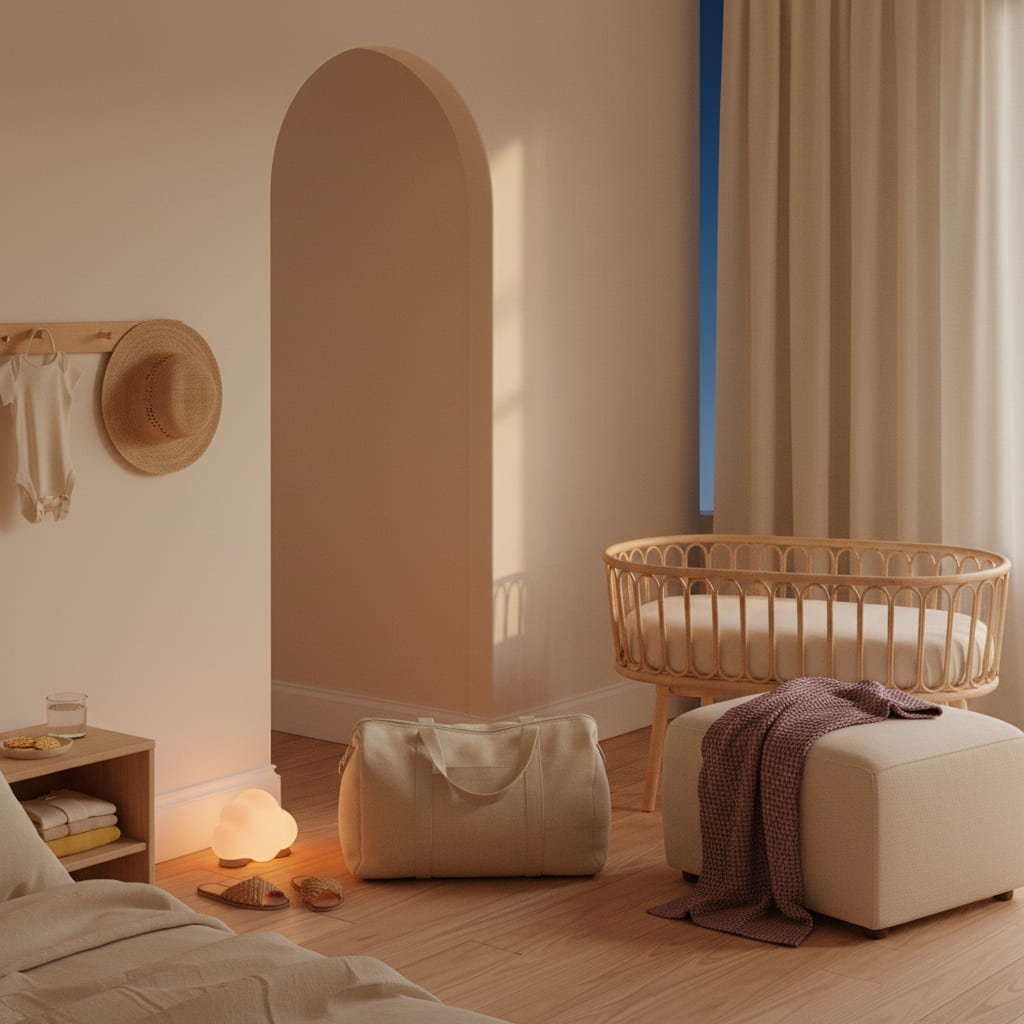
Finish the sleep space early. Not fully decorated — functional. Bassinet built, mattress in, sheets washed, positioned beside your bed. If you come home late and depleted, you want the room to already be the answer. The step-by-step is in the newborn sleep space.
Agree the night split before anyone needs it. Who is on for which stretch, and what “on” actually means. A stay pushes this from useful to essential, because one of you may be recovering from something the other isn’t.
Nominate someone to hold the outside world. One person who fields the messages, tells people not to visit yet, and answers “how is she doing” so you don’t have to fourteen times a day. That is exactly the job lining up your village exists to fill.
Know where your notes are. A longer stay generates paperwork, follow-up appointments and weight checks. One folder, one bag, decided now.
What actually rebuilds a night
Not technique. Setup and repetition, in that order.
A dark, boring room. The same short sequence of events every evening, in the same order, however wobbly the timings are. One adult genuinely on duty rather than two half-awake ones. And feeding on whatever rhythm your provider has asked for, which after a hospital stay may not be the rhythm you had imagined — that instruction outranks anything you have read, here or elsewhere.
Expect the rebuild to be uneven, especially if your baby came home under the weather or on the back of an infection; Betteroo’s guide to what illness does to a baby’s nights is honest about how long the recovery tail runs and how much of it is waiting rather than fixing. Having a sleep plan you can pick back up rather than reinvent is worth more after a disrupted start than a perfect one, which is a large part of why I did the thinking before the birth this time rather than after.

If it was you who stayed longer
Half of these stays are not about the baby. A longer recovery, a cesarean, something that needed watching — and then you come home needing to be looked after while looking after a newborn.
The honest version of that arithmetic is that you cannot do both at full strength, so the night split stops being a nicety. It is the plan. What your body is doing at 3am is the piece I’d read at 34 weeks rather than after the fact, and Tales of a New Mom covers c-section recovery in the first week properly.
For the arriving side generally, her first night home with a newborn is the read, and if the stay was a NICU one, The New Moms Club has the first month home as a NICU graduate. I do the waiting; they do the rest.
Call your OB or midwife if…
Everything about your baby’s care after a hospital stay — feeding instructions, follow-up appointments, sleeping position — comes from the team who discharged you, and there is no such thing as calling them too soon. While you are still pregnant, the usual list stands: bleeding, fluid leaking or a gush, contractions before term, severe headache or vision changes, sudden swelling of your face or hands, fever, severe or one-sided abdominal pain, a fall, dizziness or fainting, or a decrease or change in your baby’s movement pattern all mean call the same day.
FAQ: nights after a hospital stay
Will a hospital stay ruin my baby’s sleep routine?
There is no routine to ruin in the newborn weeks. What a stay changes is your starting point and your energy, not your baby’s habits.
Should my baby sleep at home the way they slept in hospital?
No. Hospital positioning can be medical and monitored; home sleep follows AAP safe sleep — back, firm and flat, in your room, nothing else in the space. Ask the team to confirm your baby has been moved to safe home sleep position before discharge.
How long does it take to settle back at home?
Give it a fortnight before you judge anything, longer if your baby came home unwell or early. The first week is the tail of the stay, not the shape of your nights.
What is worth doing before the birth in case this happens?
Finish the sleep space, agree the night split, pick the person who fields messages, and decide where the paperwork lives. All four are easy now and miserable to arrange later.