Preparing Your Dog for the Baby: A 6-Week Plan
The way to prepare a dog for a baby is to make every change before the baby is the reason for it. Six weeks out, move furniture, rules and routines to their post-baby versions, so the dog associates the new normal with a calm house rather than with a newborn. Then layer in the two skills that matter (settle on a mat, four paws on the floor), introduce baby sounds and gear gradually, and decide in advance who is handling the dog on homecoming day. The non-negotiable that outlasts all of it: dogs and babies are never left alone together, no matter how good the dog is.
We did this with a nervous rescue before our first, and the runway was the difference between a dog who adapted and a dog who was ambushed.
Why six weeks, and why not the week before
Dogs are excellent at spotting that something has changed and terrible at knowing why. If the crate moves, the sofa goes off-limits and the morning walk shifts an hour later all in the week the baby arrives, the dog draws the obvious conclusion — the baby caused every loss. Space the changes out and each one is just Tuesday. Six weeks is also long enough that you can still bend down and hold a leash comfortably. Reading this at 38 weeks? Compress the plan, keep the order.
Weeks 6–5: change the map and the rules
Structural changes first, while nothing else is happening.
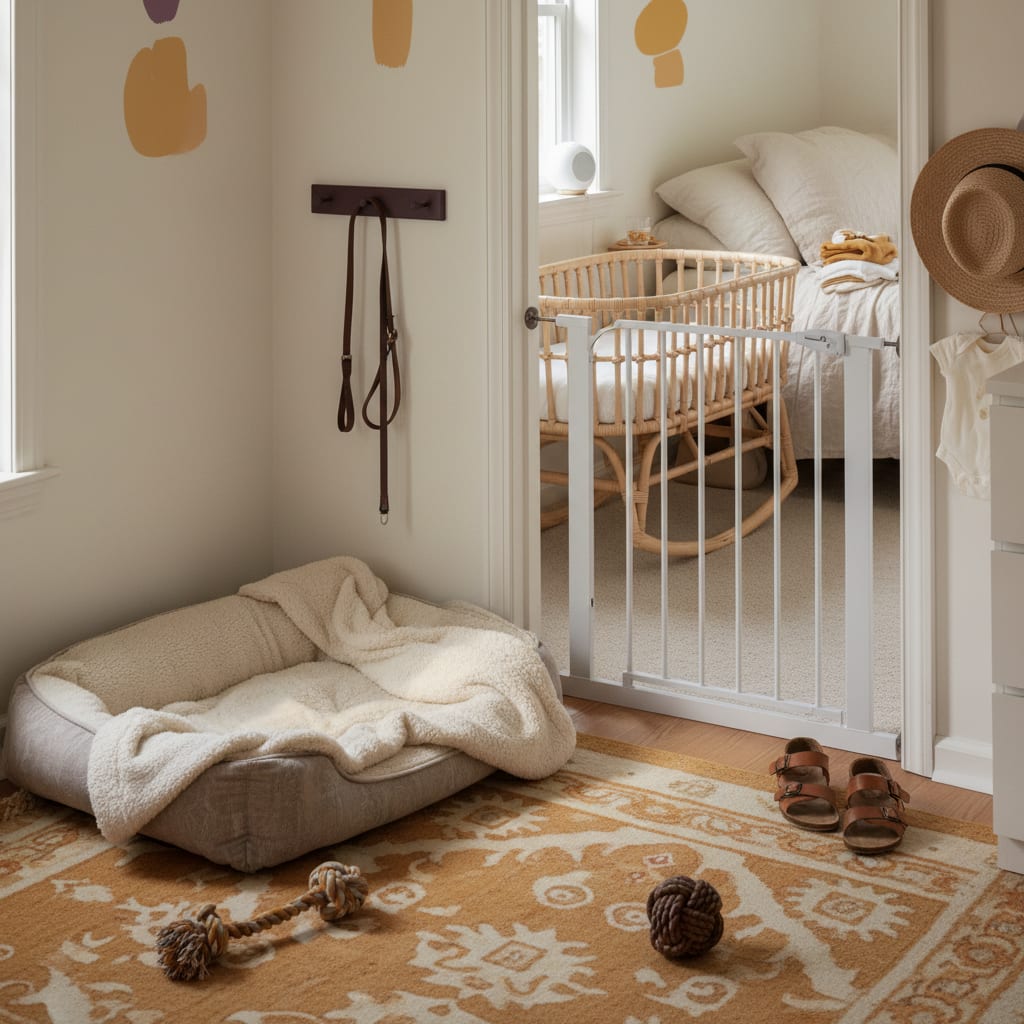
- Move the dog’s things to their permanent post-baby spots. Bed, crate, bowls — wherever they’ll need to be once there’s a bassinet and a pile of gear in the room. Move them once, now.
- Set the room rules. If the nursery will be off-limits or leash-only, start now — door closed, dog rewarded for settling outside it. If they’ll be allowed in on invitation, practice that version instead.
- Change furniture privileges now if you’re going to. Renegotiate the sofa in week six, not week zero.
- Shift walk and feeding times toward the realistic new schedule — later, more variable. A dog who expects a 7am walk on the dot will find newborn life a personal insult.
- Book the vet check. Vaccinations and parasite prevention current, and any lingering health issue seen to while you have the bandwidth.
Weeks 4–3: teach the two skills that actually matter
You don’t need an obedience portfolio, just two behaviors.
Settle on a mat. A designated bed the dog goes to and stays on while something interesting happens elsewhere in the room. Build it in tiny increments — a treat for stepping on it, then for lying down, then for staying as you step away — and practice it where you’ll need it: the feeding chair, a stroller going past, someone at the door.
Four on the floor. No jumping on the person carrying things. Reward calm greetings, turn away from the jump, start early, and get everyone in the house doing it identically.
Reward-based training is what the veterinary behavior bodies (the AVSAB among them) consistently recommend, and it holds up under stress — exactly the condition you’re training for. If your dog has any history of growling, snapping, resource guarding or biting, bring in a certified professional rather than a plan from a blog. That’s the whole ballgame.
Weeks 2–1: sounds, gear and gentle handling
Now make the baby’s world familiar while it’s abstract.
Sounds. Play recordings of newborn crying at low volume during pleasant things — dinner, a chew, a training session — raising the volume over days and backing off if the dog looks worried. Do the same with the white-noise machine that will run in the sleep space; a constant new sound behind a door is its own low-grade stressor. Ours is the Yogasleep Dohm Classic, a mechanical fan-in-a-shell rather than a looped track, and running it beforehand meant it was already background by the time it mattered. The full build is in the newborn sleep space setup.
Gear and handling. Assemble the swing, bassinet and stroller now and let the dog investigate them while they’re boring — and pair gentle, slightly clumsy touching with treats, since a dog who dislikes it is telling you something useful now rather than in a year. Then practice walking the dog with the stroller — empty, on quiet streets, before it also contains your baby and your remaining nerves.
The week of: decide who does what
Write this down; it gets executed by people who aren’t thinking clearly.
- Who takes the dog when labor starts? Name a person, confirm they’re free, give them a key, tell them where the food and leash live. Have a backup.
- How long can the dog be alone? If you’re gone 48 hours, someone is doing walks and feeds. Book it now, including the 3am-on-a-Sunday version.
- Where does the dog stay for the first hour home? Crated, in another room, or out on a walk — decided in advance, not “we’ll see.”
It belongs on the same page as the rest of your pre-baby admin — it’s a logistics problem wearing a fur coat.
Homecoming day: the actual choreography
The version that works is boring on purpose.
- Someone walks the dog properly before you arrive. A tired dog makes better decisions than an excited one.
- The birthing parent greets the dog first, without the baby. After days away, that reunion needs to be about them — the baby stays with another adult in a different room for five minutes.
- Then a calm, leashed introduction. Loose leash, baby held securely by a seated adult, everyone rewarded for calm. Sniffing feet is fine. Faces are not.
- Keep it short and end it early, before the dog gets over-aroused. Several short sessions over days beat one big meeting.
- Keep the routine intact for the first week. The walk still happens, the chew still appears, and the dog still gets ten minutes of undivided attention — ideally while the baby is asleep in the bassinet.
The rules that never bend
Everything above is technique. This part isn’t negotiable, and it applies to the sweetest dog you’ve ever met:
- Never leave a dog and a baby alone together, not for a second, not to answer the door. Every set of guidance on this — the AAP’s, the AVMA’s, every behaviorist’s — agrees, and reported incidents almost always include the phrase “I was only out of the room for a minute.”
- Use physical barriers, not vigilance. Baby gates and closed doors work when you’re exhausted; attention doesn’t. Baby gear on the floor is not supervision.
- Feed the dog somewhere the baby will never crawl. Food and chews are the most common flashpoint, and a separate spot is far easier to establish now than to relocate later.
- Watch for stress signals — lip licking, yawning, whale eye, turning away, leaving the room. A dog who removes themselves is doing the right thing, and should always have somewhere to go.
Call your vet or a professional if…
Get help before the birth — vet or certified veterinary behaviorist — if your dog:
- Has ever growled at, snapped at, or bitten a person
- Guards food, toys, beds, or a particular person
- Is fearful or reactive around children, strangers, or sudden movement
- Has separation-related distress that a change in routine will worsen
- Shows a sudden behavior change during your pregnancy — that’s a vet visit, because pain and illness show up as behavior
There’s no shame in the answer being “this dog needs a management plan” — better that conversation at 30 weeks than improvising at 3am with a newborn on your shoulder. And if the last weeks are wearing you down while you do it, the third trimester comfort tactics are what make dog-training-from-a-chair possible.
FAQ: preparing a dog for a new baby
How far in advance should I start preparing my dog?
Six weeks suits a typical dog; two to three months suits an anxious or reactive one. What matters is that each change lands well before the baby can be blamed for it.
Will my dog be jealous of the baby?
“Jealous” is the wrong frame, but dogs do notice when attention and predictability drop. Keep the walk, the food schedule and a short daily block of one-on-one time, and make good things happen while the baby is present.
What about cats?
Same early start, plus one pregnancy job to hand off: the litter box. Both are in pregnant with a cat.