Working While Pregnant: Desk, Feet, and Energy Logistics
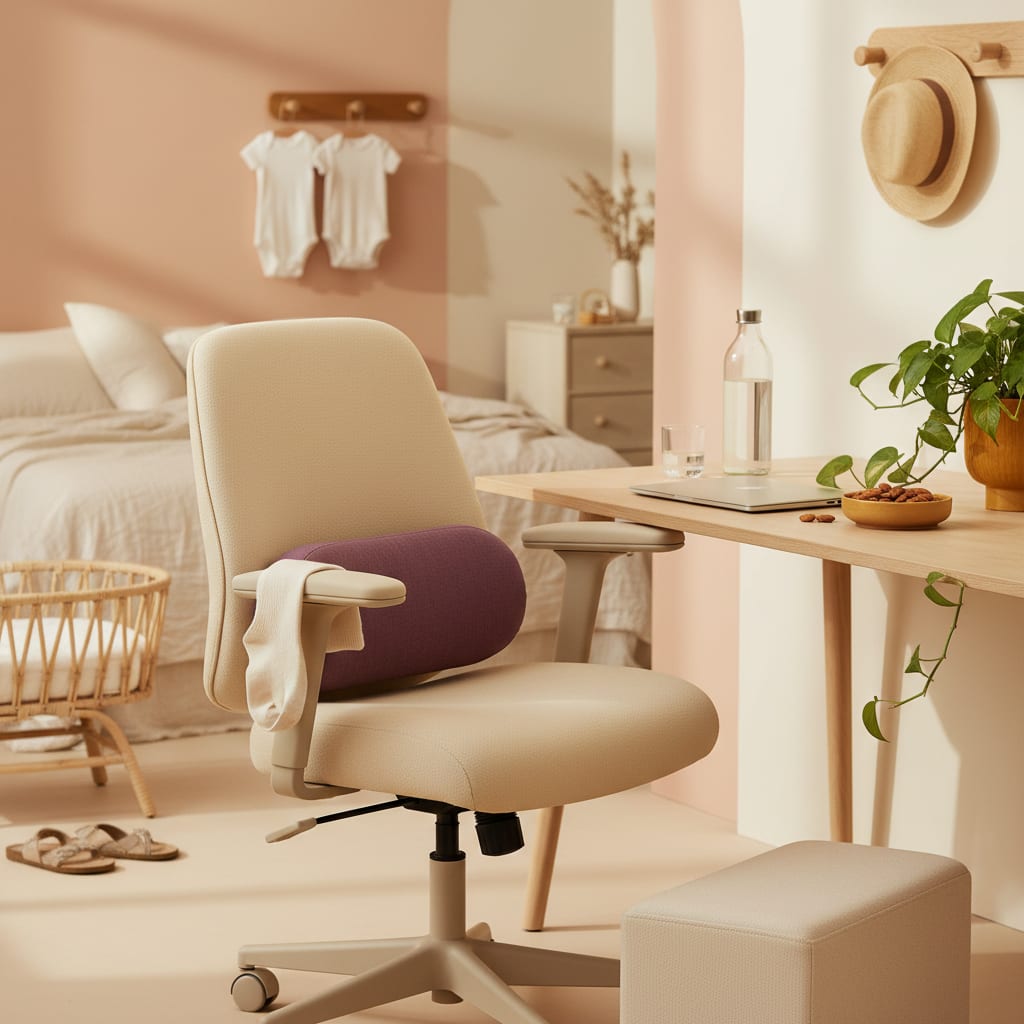
Working while pregnant is a logistics problem wearing a wellness costume: the fixes that matter are unsexy — a chair set up for a changing body, movement breaks on a timer instead of on vibes, compression socks if you stand, snacks stationed within reach, and an energy budget that treats your calendar as negotiable and your rest as not. None of it requires announcing anything before you’re ready or becoming the office’s pregnancy ambassador. It requires about an hour of setup and the willingness to stop performing your pre-pregnancy work persona.
I coordinated events through most of my first pregnancy — a job that is 60% standing on concrete and 40% pretending everything’s fine — so this is the field-tested version.
The two-body problem of the workday
Your job was designed for the body you had in January. The chair, the commute, the standing shifts, the 4pm energy expectations — all calibrated to a person who isn’t building a second person on the side. The workday doesn’t get harder linearly, either: the first trimester is a stealth exhaustion problem while you’re keeping the secret, and the third is a mechanical one while everyone can see exactly why you’ve stopped taking stairs.
The mindset shift that helps: you’re not underperforming your old baseline, you’re running a second full-time process in the background. Adjust the workstation, not your sense of worth.
The desk configuration
For desk workers, the bump changes your geometry a little more every week — the setup wants a monthly re-tune:
- Chair height so feet rest flat, with a small footrest (or a box — glamour optional) to take the pressure off your lower back as the bump grows.
- Lumbar support: a small cushion or rolled sweater at the curve of your back. Your spine is doing extra shift-work; give it a co-worker.
- Scoot the chair closer and the keyboard nearer as the bump arrives — reaching over it wrecks your shoulders by Thursday.
- The hourly stand-and-stroll. On a timer, not on memory. Sitting is fine; fossilizing is the problem. Two laps of the office, refill the water, sit back down. (ACOG’s general posture on staying active during pregnancy backs regular movement — your own OB gets the final word on your specifics.)
If no configuration makes sitting bearable by late afternoon, that’s not a desk failure — late-pregnancy positioning has its own playbook.
The standing-shift survival kit
Retail, teaching, nursing, events: standing work while pregnant is its own tier. The swelling math is straightforward — fluid plus gravity plus hours — and the counters are:
- Compression socks, worn from the morning, before the swelling starts, not after. This is the one product in this post that earns a name: graduated compression socks like Physix Gear’s are the canonical worked example — cheap, washable, and the difference between ankles and “cankles by lunch” for a lot of standing workers. (If your provider has said anything about compression for your circulation specifically, their spec wins.)
- Micro-sits. Thirty seconds of perching counts. Find every legitimate perch your workplace owns and use them shamelessly.
- The end-of-shift elevation ritual: ten minutes, feet above heart level, before you attempt the evening. It’s the reset button.
- Shoes with real support, possibly a half-size up by the third trimester. Fashion took a leave of absence; it’ll be back.
The energy budget meets the calendar
Your daily energy is now a fixed allowance, and the workday will happily spend all of it. Defenses that worked for me: put the hardest task in your best hours (mornings, usually, once the nausea era ends); decline one nonessential meeting a week and notice that nothing happens; eat before the hunger cliff — a stationed snack drawer prevents the 3pm system crash; and protect the evening shutdown, because tonight’s sleep is tomorrow’s entire productivity plan.
The HR conversations — signposted, not advised
Leave policy, accommodations, timing your announcement at work, what your state requires: all real, all important, and all specific to your employer and your jurisdiction — which is why this section is short. Ask HR directly about your leave options and accommodation process (you can ask hypothetically before announcing, or have a trusted colleague ask about “a friend”). If you need workplace adjustments — more sitting, fewer heavy lifts, schedule shifts — that’s a conversation for HR and your OB together; providers write accommodation notes constantly and yours will know what to say. I’m the comfort-logistics correspondent; the legal stuff deserves actual professionals.
Call your OB or midwife if…
Work discomfort is normal; some things are flags. Call promptly for: sudden swelling (especially face or hands), severe headache or vision changes, dizziness or fainting at work, contractions-that-feel-like-something before term, bleeding, fluid leaking, or a noticeable drop in the baby’s movement during the day. And if your job involves heavy lifting, chemicals, or long extreme shifts — bring the actual job description to a prenatal visit and get real guidance for your real work.
FAQ: working while pregnant
How long can you work while pregnant?
There’s no universal cutoff — plenty of people work until labor starts; others stop earlier for medical or logistical reasons. It depends on your pregnancy, your job’s demands, and your OB’s advice, which is exactly the conversation to have around the start of the third trimester.
Do compression socks really help at work when pregnant?
For standing-heavy jobs, they’re one of the highest return-per-dollar comforts going: graduated pressure counters the fluid pooling that makes ankles balloon by mid-shift. Put them on before work, not after swelling starts. Mention circulation concerns to your provider — and sudden severe swelling is a call, not a sock problem.
When should I tell work I’m pregnant?
Whenever suits your situation — there’s no etiquette deadline. Common triggers: needing accommodations, visible showing, or wanting leave planning to start. Know your company’s policies first (HR can be asked discreetly), and tell your manager on your terms, not the rumor mill’s.
How do I fight pregnancy fatigue at work?
Budget, don’t boost: hardest work in your best hours, one declined meeting a week, stationed snacks before the hunger cliff, and a genuinely early bedtime. Caffeine is a question for your OB regarding amounts; naps in parked cars at lunch are a question for no one — they’re excellent.